Miden is a leading project bringing privacy to Ethereum, and we've been working with the team for over a year. This post covers our contributions to the Miden ecosystem during Q1 2026.
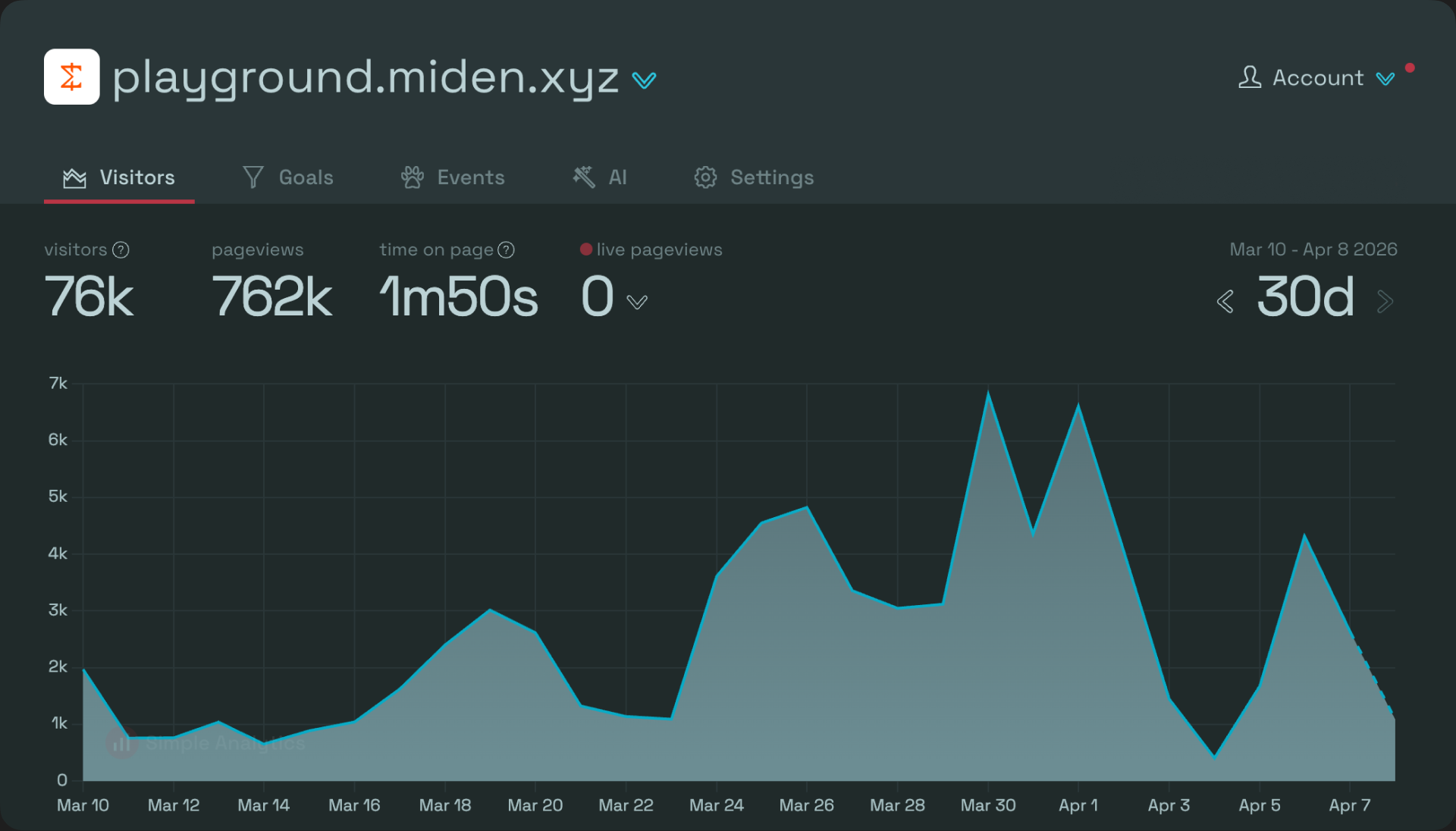
The quarter's work spans four main areas. The Miden Playground we built saw strong growth, with weekly visitors going from a few thousand to over twenty thousand. The transaction debugger went from stepping through isolated Rust execution to a full transaction-level debugging stack, reaching developers with the next Miden releases. midenup, Foundry-like tooling for Miden developers, started taking shape. And our contract verification API shipped inside MidenScan, giving Miden on-chain contract verification for the first time.
Miden Playground
Why it matters: To grow its developer base, Miden needs a low-friction on-ramp, and the Playground fills that role. This quarter it handled a lot more traffic, got faster, and added tutorials that cover more realistic use cases.
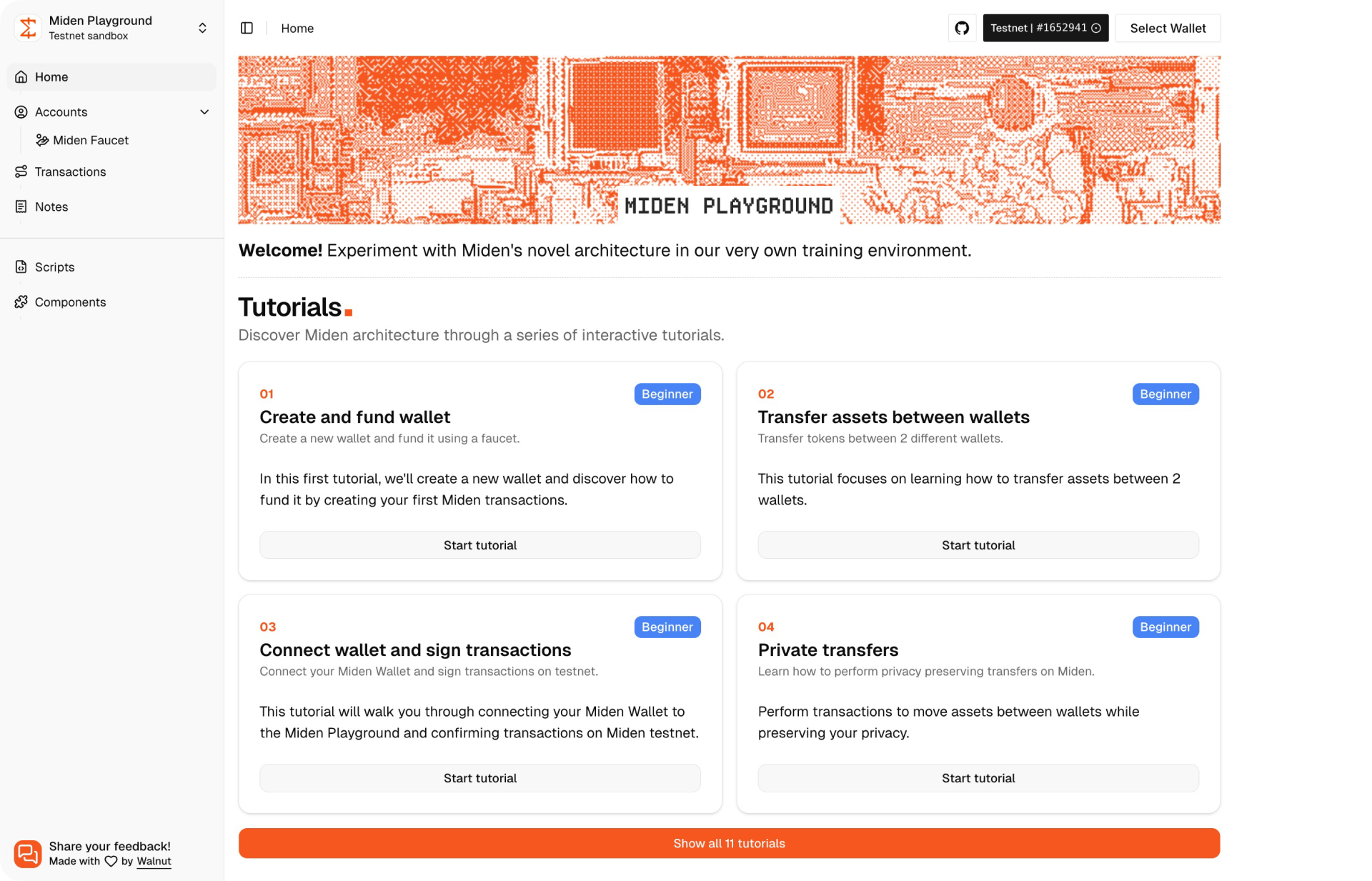
The Miden Playground is where most developers first write and deploy code on Miden. We built it last year and continue to maintain and expand it. It's a browser-based environment for building smart contracts, with guided tutorials that walk through real use cases from first contract to privacy patterns.
The Playground saw strong growth this quarter. Weekly visitors went from roughly 2,600 in early February to 25,000 by the end of the quarter. The tutorial numbers reflect the same growth: around 2,800 completions a week in early February, and closing out at 25,000 completions and 65,000 starts in that final week. Quality tracked alongside: 79% of developers rated the tutorials "clear" or "crystal clear," up from 62%.
We played a part in that growth with four new tutorials covering Rust smart contract development (Your First Smart Contract, Contract Verification) and privacy (Private Transfers, Wallet backup using Miden Guardian). Guardian, for example, walks developers through setting up wallet recovery using a multisig pattern built on OpenZeppelin's guardian infrastructure: a backup, synchronization, and coordination layer for private accounts. These tutorials put developers through real workflows on a live testnet.
Try them out in the Playground.
First-run response time on the Rust compilation API went from over a minute to seconds. That's the compile step behind every tutorial and every contract developers build in the Playground, so faster compilation means faster iteration. This improvement also matters for contract verification, where every recompilation hits a cold start.
Up next, we're building a Developer Console: a Remix-style layer with full-featured examples that load as mini-apps inside the Playground. That work is landing next quarter.
Debugger & Compiler
Why it matters: Writing secure and reliable contracts means being able to step through execution, spot problems early, and iterate without guessing. We're bringing that to Miden with full end-to-end transaction debugging.
Miden is building a compiler that lets developers write smart contracts in Rust. Those developers need a debugger: something that lets them step through execution, inspect variables, and get meaningful error messages when something breaks. We're core contributors to both the compiler and the debugger, working directly with Miden's core team.
Before this quarter, the debugger could step through Rust logic but stopped at the boundary of a full transaction, where execution crosses into kernel calls. Closing that gap required coordinated changes across the protocol, VM, and debugger: a hook so developer tooling can intercept transaction execution without changing default behavior, VM changes to expose internal processor state after each step, and a transaction-level debugging layer in the debugger itself. We also added VM infrastructure that will sharpen the experience once it ships: procedure names stored as readable labels instead of hashes, variable locations tracked at each execution step, and cleaner stack traces. Client-side integration, the final piece that brings full end-to-end transaction debugging into developers' normal workflow, will reach developers with the next Miden releases.
midenup
Why it matters: Foundry made building on Ethereum actually productive. Miden needs the same, and we're helping build it.
midenup is Miden's equivalent of Foundry: a command-line toolkit for local development, testing, and deployment.
We're working with the Miden DevEx team to define and build this from the ground up. The first building blocks are miden call for invoking contracts and miden anvil for running a local Miden node. Both are in early stages.
The bigger picture is a full local development stack for Miden: cheatcodes for testing, transaction simulations, integration with our debugger's execution traces, and the kind of workflow tooling Ethereum developers already have. Building this out is going to be a major focus for us over the coming quarters.
Contract Verification
Why it matters: This is the first on-chain contract verification tooling for Miden. Developers and auditors now have a way to confirm that what's deployed matches the published source, and teams are already using it.
Contract verification is how users confirm that the code running on-chain matches the source a developer claims to have deployed. Every blockchain needs it. Without it, trust in deployed contracts is just a promise.
We built a contract verification API for Miden. This quarter, the Gateway.fm team integrated it into MidenScan, their block explorer for Miden. Verified contracts are now visible directly in the explorer.
Next, we're extracting the verification service into its own repository so anyone can self-host it. This is the basis of what will become Miden's equivalent of Sourcify: open contract verification infrastructure that any explorer, wallet, or tool can plug into.
The CLI counterpart we're building is miden-verify, which recompiles local Rust source and checks the resulting output against what's deployed on-chain. It closes a gap in the deploy-verify loop for those who prefer the terminal.
x402 on Miden
Why it matters: x402 enables any API to accept payments via a standard HTTP header. On Miden, that means programmatic, proof-verified micropayments, opening the door to agentic payment flows on a ZK-native chain. We designed the first x402 spec for this model.
We designed a spec for @x402/miden: an SDK and hosted facilitator service that lets any API accept Miden micropayments with no Miden-specific knowledge required from the merchant. The challenge is Miden's two-phase transfer model. A payer creates a note, then the recipient consumes it. This breaks x402's assumption that settlement is atomic. Our design uses unauthenticated notes so both phases land in the same block. A ZK proof covers both steps rather than a signature, and a nullifier prevents double-spend. The facilitator handles the full settlement lifecycle, so merchants never need to touch Miden infrastructure.
As designed, this would be the first x402 implementation on a ZK-native chain and the first to settle through proof verification rather than signature verification.